Springs · Caledon
Garage Door Cable Replacement
Someone left the snow shovel leaning in the opening and the door came down on it. Now a loop of steel cable hangs loose beside the track and the door refuses to close the last few inches.
Garage Door Cable Replacement
In plain words
Cables are replaced as a pair, and there is a practical reason. Both went on the door together, have made the same number of trips and have sat in the same slush, so when one fails the other is close behind. A new cable beside a stretched one also pulls the door slightly out of level. Fitting two matched cables of the same length and construction lets the technician set the door dead level, tension both sides equally and leave a counterbalance that shares the work evenly for years. It also means one visit rather than two.
How the visit goesAfter years of slushy winters the cables look thinner near the bottom brackets, with rust streaks running down the door where they attach. The door still works, but the frayed wires catch your glove when you brush past.
Caledon
How the visit goes
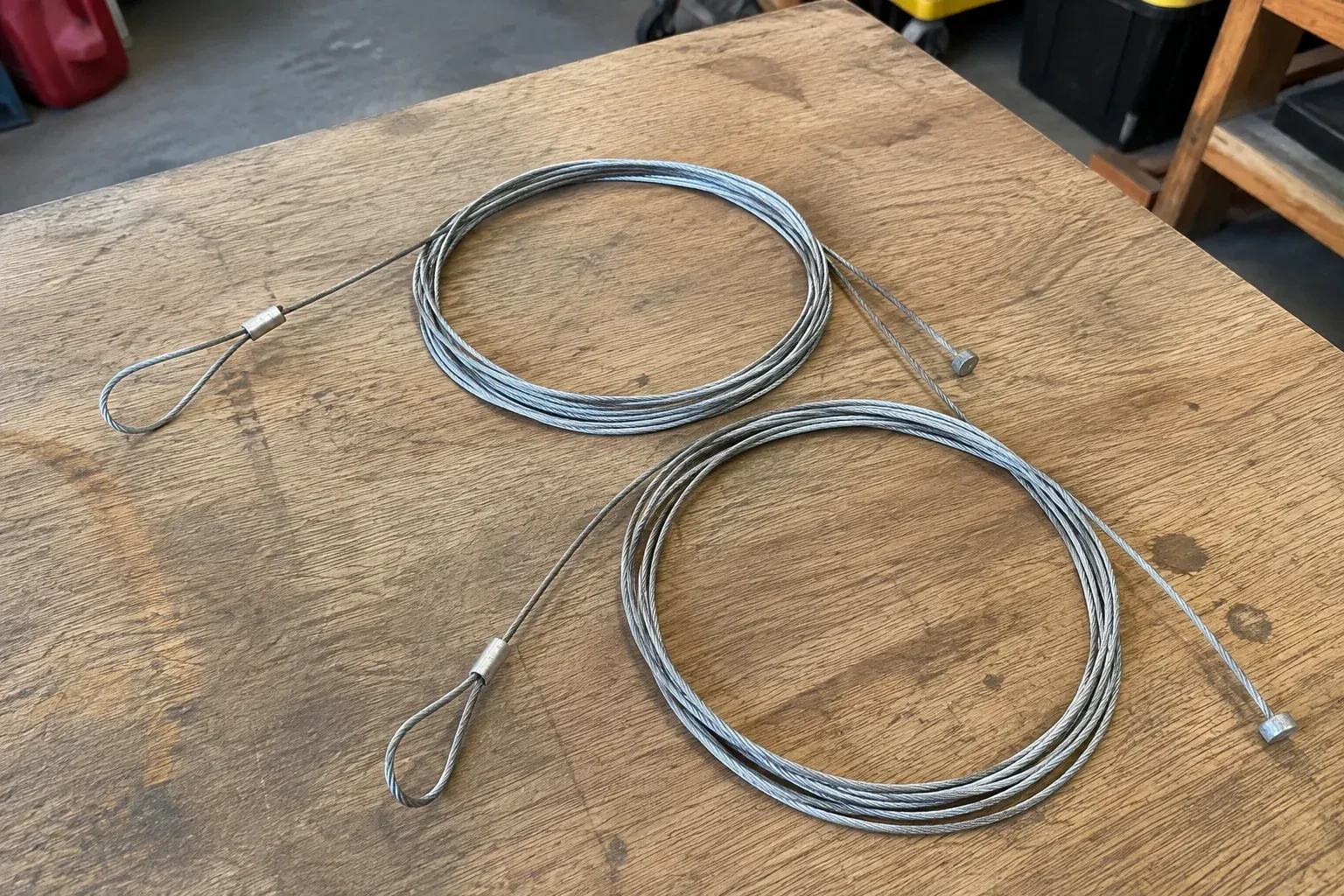
Both cables, side by side
Both cables are examined even when only one has failed, because they are the same age and have made the same trips. The technician looks along each for broken wires, thinning near the bottom loop, rust bloom, kinks, and flattened spots where the cable has rubbed. The ends get particular attention: the swaged stop that seats in the drum and the loop or ferrule that rides on the bottom bracket pin. The two are compared for length as well, since a stretched or slipped cable shows as one corner of the door sitting higher. This comparison decides what is fitted and explains any crookedness you have noticed.
Balance, travel and the opener
With the springs wound and the clamps off, the technician lifts the door by hand. It should rise with light effort, hold still at roughly waist height, and settle to the floor without slamming; that is the balance test, and the spring turns are adjusted until it passes. The door is run through several full cycles by hand while the cables are watched on the drums. Then the opener is reconnected, its travel limits and force settings are checked against the newly balanced door, and the reversing test with a block under the door and the photo-eye test are carried out. You see each of these done.
Lubrication that helps, and where it does not belong
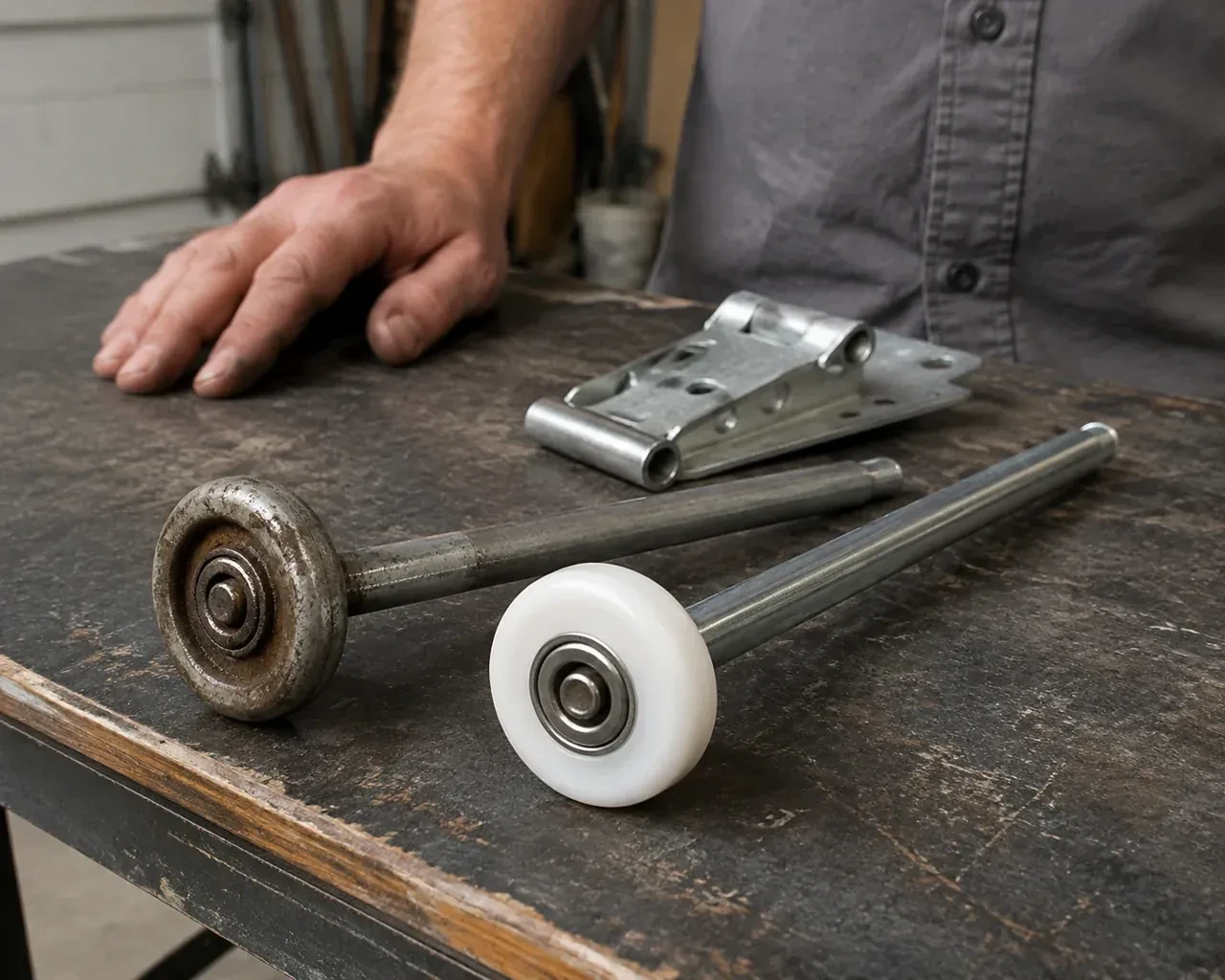
A few minutes with a can of garage-door lubricant twice a year keeps the whole system easy on the new cables. Spray the torsion spring lightly along its length, the hinge pins, the roller stems and bearings, and the bottom bracket pins, then run the door a few times to spread it. A light mist on the cables themselves slows rust; heavy grease is avoided because it holds grit and moisture. The tracks are left dry and simply wiped clean, since lubricant there collects dirt and lets rollers slide instead of roll. Silicone or a lithium spray made for doors is the right product.
Garage Door Cable Replacement
In the van
- Clevis pins and cotter pins
- Track clamps or locking pliers
- Silicone garage-door lubricant
- Bottom rollers and hinges
- Extension-spring pulleys and sheave forks
What affects the quote
Same fees day, night or weekend
1Whether a matching part has to be special-ordered
Most drums, brackets and cable sizes are common stock, but an older or uncommon door sometimes needs a part matched to its exact dimensions. When that happens the technician identifies it on the first visit and arranges the part before the return trip.
2Door weight and width
A heavy insulated double door needs a heavier cable and sometimes different drums than a light single, and the springs behind it take longer to wind down and back up.
3Condition of the bottom brackets
A bracket bent by a bumper or corroded by years of salt is replaced while the system is unloaded. New brackets, roller and fasteners are listed as their own line.
Garage Door Cable Replacement: questions
What is the difference between a lift cable and a safety cable?
A lift cable does the work: it connects the door's bottom corner to the spring system and carries the door's weight. A safety or containment cable does no lifting at all. It runs through the middle of an extension spring and is anchored at both ends so that if the spring breaks, the pieces stay put. Torsion springs sit on a shaft and do not need one.
How do I tell a cable problem from a spring problem?
Look above the door with it closed. A torsion spring that has broken shows a clear gap in the coil, and both cables usually go slack together because nothing is turning the shaft. A cable problem tends to show on one side only: a frayed length, a coil of loose cable, or one corner sitting higher. Either way the technician inspects both, since a weak spring is a common reason a cable fails.
Can I lift the door by hand while a cable is off?
Leave it. With one cable slack the door is being carried on one side only, so it is unbalanced and may bind or drop unevenly when moved. The technician arrives with clamps and a method for taking the door's weight before anything is moved, and that is the moment to lift it. Until then a stationary door is exactly what you want.
Springs & Hardware
Garage Door Cable Replacement near you
A garage door in Caledon rarely fails all at once. It gets louder, slower or less even first. Our services are arranged so you can act at any point: a tune-up while it is still working, a repair when something lets go, or a replacement when the door has earned its retirement.