Openers · Caledon
Garage Door Opener Diagnosis and Repair
The motor runs, the chain rattles along the rail, and the door does not move a millimetre. You notice the little carriage sliding back and forth on its own.
Garage Door Opener Diagnosis and Repair
In plain words
Think of a command travelling through the system. Your thumb presses a button; the radio signal reaches the receiver; the logic board decides to move; the motor turns; a gear drives a chain, belt or screw; the trolley pulls the arm; the arm moves the door. A fault at any link produces the same result from where you stand: nothing happens. Diagnosis walks that chain in order and finds the broken link, whether it is a flat remote battery at the start or a stripped gear in the middle. Working from one end keeps the fix small and the explanation simple.
How the visit goesThe motor runs, the chain rattles along the rail, and the door does not move a millimetre. You notice the little carriage sliding back and forth on its own. Last week the power was out and someone pulled the red cord to get the car out.
Caledon
How the visit goes
From motor to trolley
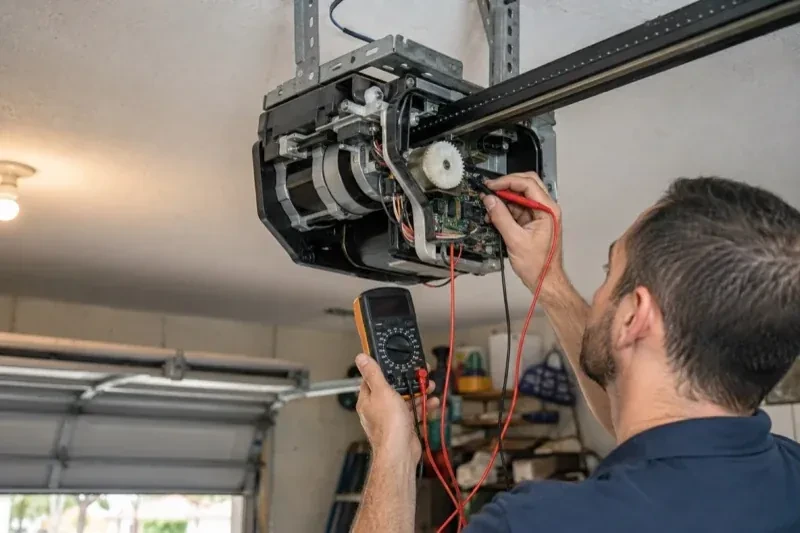
Behind the cover of the head unit and along the rail sits the drive train: motor, capacitor on AC models, drive gear, sprocket, and then the chain, belt or screw that moves the trolley. The technician listens first, because sounds are specific. A hum with no motion suggests a capacitor or a stripped gear; a motor that runs while the trolley slides alone points to a disengaged carriage or a broken drive; a grinding start followed by silence is a worn gear finishing its life. Then the parts are inspected directly: gear teeth, sprocket, chain tension, belt condition, trolley wear, and the coupling between rail and head.
Capacitor and motor work
On an AC opener that hums and clicks but never turns, the start capacitor is the first suspect. It is discharged, tested and replaced with one of the same rating, a routine job that returns a dead-sounding opener to normal in many cases. If the motor still fails to turn with a good capacitor, the technician checks for a seized shaft, burnt windings or a failed thermal cut-out, and confirms the motor is not simply being stalled by a locked or bound door. A motor replacement is weighed against the age of the unit and the availability of the part, and that judgement is explained before any decision.
Knowing the red handle
The red cord hanging from the rail is the emergency release, and you now know how to use it properly. Pull it only when the door is closed, so a door that turns out to be unbalanced has nowhere to fall. The door then lifts by hand, useful during an outage. To reconnect, most units re-latch when the opener is run and the trolley meets the carriage, or when the door is lifted until it clicks. The handle should hang no higher than about 1.8 metres and clear of the car. If the door feels heavy when released, that is a spring message, not a test of strength.
Garage Door Opener Diagnosis and Repair
In the van
- Garage door lubricant
- Bell wire and clips
- Chain or belt
- Logic board or receiver
- Wall control
What affects the quote
Same fees day, night or weekend
1Connected features
A unit with a network module, door-position sensor or hub may need its pairing restored or a module replaced, which is quoted as its own step alongside the mechanical repair.
2Whether the door needs work first
If the by-hand check shows a heavy or binding door, the balance, rollers or springs are corrected before the opener is judged, and that door-side work is quoted as its own item.
3Remotes and keypads
Each remote or keypad to be reprogrammed, re-batteried or replaced is counted individually. Say how many devices you have so the quote reflects all of them.
Garage Door Opener Diagnosis and Repair: questions
Why does my door go back up when I try to close it?
The opener believes something is in the way. Either the photo-eye beam near the floor was broken, misaligned or blocked, or the door met more resistance than its force setting allows, often from a frozen seal, stiff rollers or a travel limit set slightly too long so the door hits the slab. The indicator light on the head unit usually tells which of the two it was, and the technician confirms it by testing rather than guessing.
The motor hums but the door stays put. What is usually wrong?
A hum with no movement means the motor is receiving power but something is stopping it turning, or stopping its turn from reaching the door. On AC units a failed start capacitor is the common cause; on chain-drive heads a stripped nylon drive gear is the other. Less often the trolley has simply been released from the carriage. Each of these is a routine repair once identified, and the hum is one of the more helpful sounds an opener makes.
Should I lubricate the chain, the rail or the track?
Rollers, hinges, bearings and springs benefit from a garage door lubricant once or twice a year. The chain, belt or screw-drive rail is a separate question, since each drive type calls for its own product and schedule from the opener's manual rather than one rule for every unit. The track itself should stay clean and dry, because lubricant there collects grit and makes rollers slide instead of turning. The technician can point out the spots on your door at the end of the visit.
Openers & Access
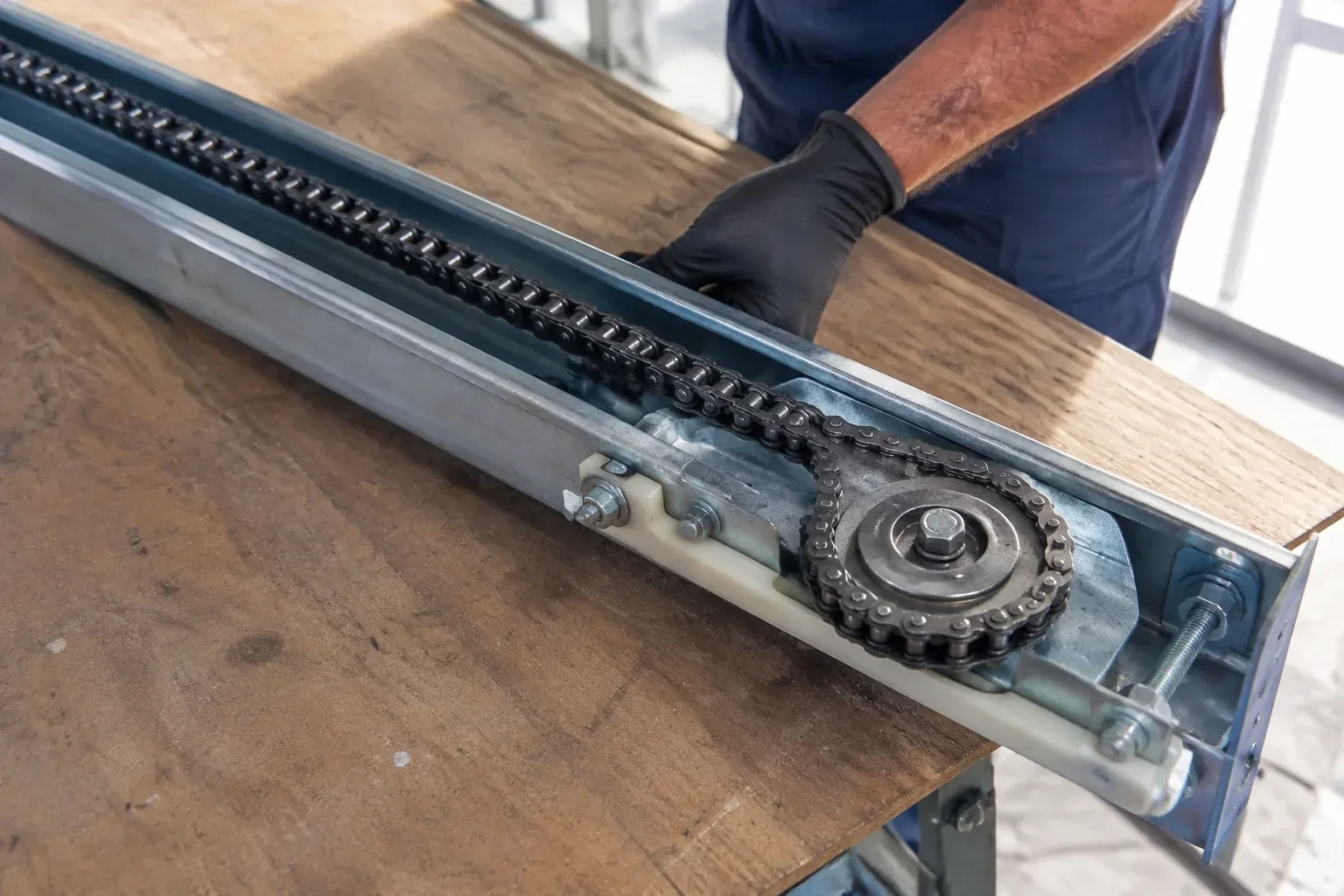
- Belt-Drive Opener RepairSomeone tightened the belt last month to stop the sag.
- Garage Door Opener ReplacementYou swapped the old wooden door for a heavier insulated steel one, and the twenty-year-old opener…
- Photo-Eye Sensor Alignment or ReplacementSince shelving went up along the garage wall, the door will not close and both sensor lights are…
Garage Door Opener Diagnosis and Repair near you
A garage door in Caledon rarely fails all at once. It gets louder, slower or less even first. Our services are arranged so you can act at any point: a tune-up while it is still working, a repair when something lets go, or a replacement when the door has earned its retirement.